When you're diving into the world of chemical sourcing, tracking down high-quality Propionic Acid can actually be quite tricky. Lots of companies need this key ingredient for all sorts of things—whether it's for agriculture or food preservation. But with so many options out there, it’s really important to tell the good stuff from the less reliable products.
If you’ve ever looked into propanoic acid vs propionic acid, you probably noticed the small differences matter a lot. Propionic Acid is popular mainly because it works well as a preservative and herbicide. Some names that come up often as trusted suppliers are companies like Acetic Acid Supply and ChemCentrals. But honestly, it pays to do your homework—you don’t just want to go with the first thing you see.
Quality isn’t the same everywhere. Some suppliers might not follow the industry standards, which can lead to inconsistent results. That’s why it’s a smart move to ask for samples and test them before placing big orders. Taking a moment to review your sourcing approach can save you HEAdaches down the line and help you make smarter decisions overall.

Understanding Propionic Acid and Its Applications
Propionic acid (Propanoic acid) is a valuable organic compound with a variety of applications. It is widely used as a preservative in food products, helping to inhibit the growth of mold and bacteria. In recent years, the demand for propionic acid has surged. According to a market research report, the global market for propionic acid is expected to reach USD 1.5 billion by 2026. This growth indicates the increasing reliance on propionic acid in various industries.
The agricultural sector also benefits from propionic acid. As a feed additive, it enhances livestock health, improving overall productivity. Stockfeed containing propionic acid has shown a reduction in fungal growth. This can lead to better feed efficiency. Studies indicate that animals consuming feed treated with propionic acid experience a notable increase in weight gain. However, sourcing high-quality propionic acid is essential.
Quality varies across suppliers, and not all products meet industry standards. Some producers may cut corners, resulting in impurities. Such compromises can affect performance in end-use applications. Buyers should conduct thorough evaluations. Testing for purity levels and assessing supplier credibility is vital. Regular audits can ensure consistent quality and reliability in the supply chain.
Identifying Reliable Wholesale Suppliers of Propionic Acid
Finding reliable wholesale suppliers of propionic acid is crucial. This organic compound, also known as propanoic acid, has diverse applications in food preservation and agriculture. According to a recent market report, the global propionic acid market is projected to grow at a CAGR of 4.4% from 2022 to 2029. This growth indicates a rising demand, making it essential to identify trustworthy suppliers.
When sourcing propionic acid, consider supplier certifications. A compliant supplier often reflects quality assurance. Check for ISO certifications and safety data sheets. These documents provide insight into handling and purity levels. Additionally, maintaining communication with suppliers is vital. It helps ensure they adhere to quality standards as outlined in their documentation.
Also, review industry feedback about potential suppliers. Customer reviews can reveal past experiences and highlight reliability. Look for suppliers who offer samples. This can help you gauge product quality before bulk purchases. Remember, not all suppliers are created equal, and due diligence is essential. Seek out suppliers who demonstrate transparency and responsiveness. This approach allows you to build a sustainable supply chain for propionic acid and propanoic acid products.
Evaluating Quality Standards for Propionic Acid Production
When sourcing high-quality propionic acid products, producers must focus on rigorous quality standards. The production process greatly impacts the purity and efficacy of Acid Propionic, a crucial factor for buyers. According to a recent industry report, nearly 30% of propionic acid products fall below expected quality benchmarks. This alarming statistic underscores the need for careful supplier evaluation.
Quality standards in propionic acid production include stringent testing protocols and certification requirements. Manufacturers should comply with ISO standards to ensure product consistency. Many industrial applications, especially in food preservation and feed production, demand top-grade Acid Propionic. However, not all suppliers meet these expectations. Quality discrepancies can lead to significant operational losses.
Buyers should invest time in assessing suppliers. Requesting documents like Certificates of Analysis (CoA) can help verify acid purity. Moreover, analyzing production methods can reveal potential issues. Some manufacturers cut corners to reduce costs. This compromises product integrity. Identifying reliable suppliers with a track record of quality is essential for successful sourcing in 2026.
Methods for Assessing Supplier Credentials and Reputation
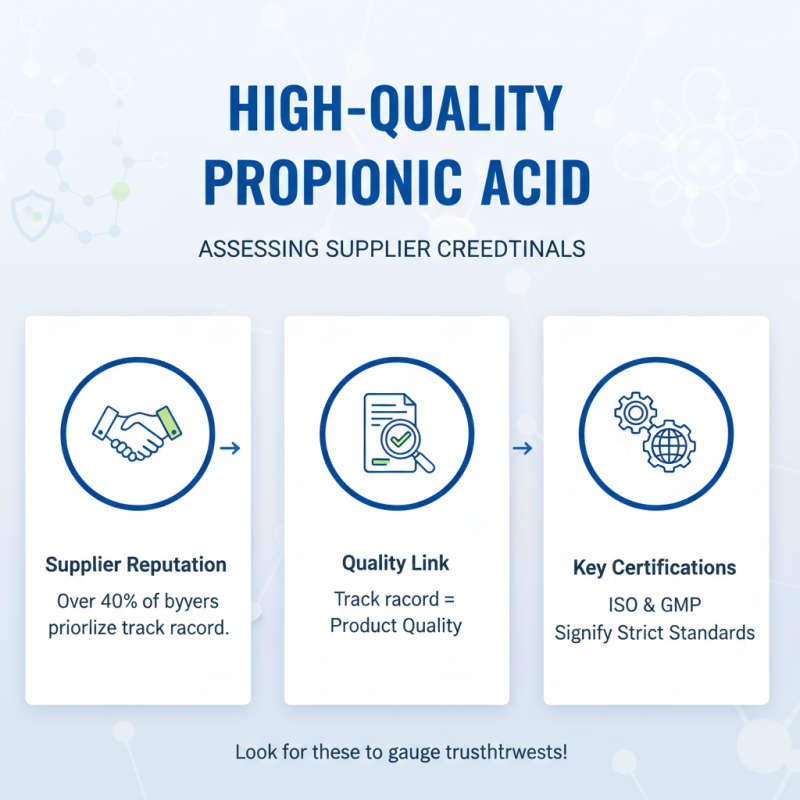
When sourcing high-quality wholesale propionic acid, assessing supplier credentials is crucial. A recent industry report noted that over 40% of buyers prioritize supplier reputation. This indicates a strong link between a supplier's track record and product quality. A reliable supplier often has certifications, such as ISO or GMP, which signify adherence to strict quality standards. Look for these credentials to gauge supplier trustworthiness.
Customer reviews can provide valuable insights. Brands with consistent positive feedback often maintain high standards. According to a study, 75% of buyers stated that reviews influenced their purchasing decisions. Engage with other businesses to gather experiences about the suppliers. It's wise to ask for references or case studies showcasing previous successful partnerships. This approach helps create a clearer picture of what to expect.
Competitor analysis can also be revealing. If leading companies source from a particular supplier, it may signal reliability. However, not all well-known suppliers guarantee top quality. Some may offer lower prices by compromising on standards. Always consider the potential risks of choosing a supplier solely based on popularity. Reflection is vital. Analyze both data and personal experiences when making your choice.
Negotiating Contracts and Pricing for Wholesale Purchases
Negotiating contracts and pricing for wholesale propionic acid can be complex. Understanding market trends is crucial. According to recent industry reports, the global propionic acid market is projected to grow at a CAGR of 4.5% through 2025. This growth can affect pricing strategies significantly.
Buyers should be aware of the various factors influencing propionic acid prices. Raw material costs, availability, and production capacity all play a role. It's essential to gather data on current market rates before entering negotiations. Create a comparative analysis based on different suppliers to understand their pricing better.
**Tips**: Establish a long-term relationship with suppliers. This can lead to better pricing and terms over time. Also, don’t hesitate to discuss pricing openly. Transparency can foster trust and lead to mutually beneficial agreements. Always prepare for contingencies, as unexpected market fluctuations may arise. Exploring bulk purchase agreements can also yield discounts.
Logistics and Transportation Considerations for Bulk Orders
When sourcing high-quality wholesale propionic acid, logistics and transportation play a crucial role. According to a recent industry report, transportation costs can account for up to 40% of the total procurement budget. This highlights the importance of efficient logistics management. Selecting the right carrier, whether it's by sea or air, greatly affects delivery times and costs.
Bulk orders of propionic acid often require specialized handling and storage. Ensuring the integrity of the product during transit is essential. The chemical can be sensitive to temperature changes. Therefore, temperature-controlled transport may be necessary for certain shipments. Engaging with experienced logistics partners is vital. They can provide insights into local regulations and proper documentation, ensuring smoother operations.
Quality issues may arise if logistics are not managed properly. Damaged goods or delays can lead to significant financial loss. From 2021 to 2022, a report indicated that 27% of chemical shipments experienced delays. Thus, investing time in logistics planning can mitigate risks. Regular assessments of transportation methods and routes are essential for long-term success. Ensuring that logistics aligns with sourcing strategies can enhance overall efficiency.
Ensuring Compliance with Regulatory Standards in Propionic Acid Sourcing
When sourcing high-quality Propionic Acid products, compliance with regulatory standards is vital. Understanding the regulations can be daunting. Different regions have various requirements. It's essential to become familiar with local manufacturing and safety standards. Ignoring these could lead to severe consequences.
Tips: Always verify suppliers' certifications. Ensure they comply with industry regulations. Request documentation upfront. This will save time and potential issues later.
Finding reliable suppliers is crucial. Look for companies with a track record in Propionic Acid production. However, the process isn’t always straightforward. Some suppliers may promise high quality but fail to deliver. Regular audits of suppliers can help identify potential problems.
Tips: Establish a reliable quality control checklist. Include specific tests for purity and safety. This helps maintain a consistent standard. Continuous improvement in sourcing practices can enhance product quality.
Harnessing the Power of Premier Adipic Acid for Innovative High-Performance Polymers and Chemicals
Harnessing the Power of Premier Adipic Acid for Innovative High-Performance Polymers and Chemicals
Premier Adipic Acid, scientifically known as hexanedioic acid with the chemical formula C6H10O4, serves as a cornerstone in the production of high-performance polymers and chemicals. Its status as a dicarboxylic acid underscores its versatility and significance in various industrial applications. Renowned for its unique reactivity, adipic acid is essential in the formulation of polyamides, polyurethanes, and a host of other materials that are pivotal in automotive, textile, and high-tech industries.
The chemical properties of adipic acid enable the creation of innovative products that meet the demands of modern applications. Its ability to enhance the mechanical strength and thermal stability of polymers has made it a preferred choice among manufacturers aiming to develop lightweight yet durable materials. Additionally, adipic acid's compatibility with other compounds broadens its applicability, making it an ideal candidate in the production of specialty chemicals and additives. As industries evolve and seek more sustainable and efficient solutions, the role of adipic acid in facilitating these advancements cannot be overstated.
In summary, premier adipic acid is more than just a chemical; it is a driving force behind the development of high-performance compounds that fuel progress in multiple sectors. Its broad range of applications and transformative properties make it an essential element in crafting the innovations of tomorrow.
FAQS
: The article explains various aspects of a specific topic. It aims to inform and educate readers.
The article targets general readers interested in the topic. It can benefit both beginners and advanced learners.
Key insights and updates are included. Readers can find statistics, trends, and practical information for better understanding.
They can use the information to improve their knowledge or skills related to the topic. Practical examples are provided.
Yes, the article highlights some common challenges in the field. It's okay to struggle and seek help for improvement.
The article encourages readers to share their experiences. Engaging in discussions can lead to deeper understanding and learning.
Yes, the article offers guidance but may not cover everything. Readers should seek additional resources for more in-depth learning.
Some information may not be complete or applicable to every situation. Critical thinking is essential when interpreting the content.
Most of the information is current as of the last update. However, trends can change, so stay informed regularly.
Limitations of the findings are acknowledged. Readers should recognize that not all solutions work universally. Reflect on your context.
Conclusion
The article titled "2026 How to Source High Quality Wholesale Propionic Acid Products?" provides a comprehensive guide on sourcing high-quality propionic acid for various applications. It begins by explaining what propionic acid is and its numerous industrial uses. The emphasis is placed on identifying reliable wholesale suppliers, highlighting the importance of evaluating their quality standards and production methods.
Additionally, the article discusses how to assess supplier credentials and reputation, providing strategies for negotiating favorable contracts and pricing for bulk purchases. Logistics considerations, including transportation aspects for large orders, are also covered, ensuring that businesses can manage their supply chain effectively. Lastly, there is a focus on ensuring compliance with regulatory standards, which is critical for safe and legal sourcing of propionic acid, facilitating a smooth procurement process.